
Any lottery entry matches versus every entry matches: a six-result worksheet
Published — UTC
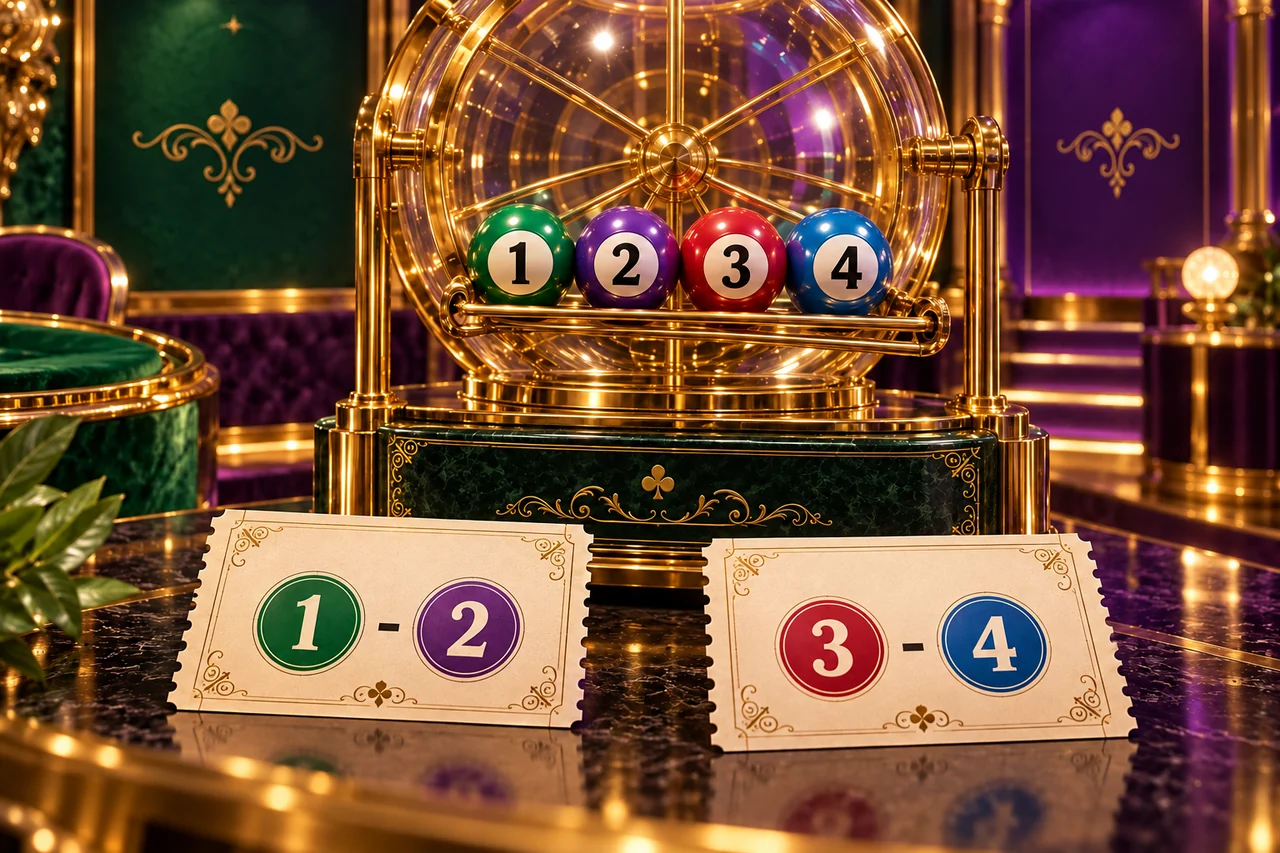
At least one accepted entry matching a result is different from every entry matching it. The distinction is easiest to see by listing a small result space before counting tickets.
One fictional draw, six possible results
Imagine four distinct balls labelled 1, 2, 3 and 4. Two are drawn without replacement; order is ignored and all six pairs are equally likely. The possible results are 1–2, 1–3, 1–4, 2–3, 2–4 and 3–4. This is a teaching experiment, not a verified lottery format.
Our two entries are 1–2 and 3–4. Each requires the whole unordered pair to match exactly.
| Question | Matching results | Count |
|---|---|---|
| Does entry 1–2 match? | 1–2 | 1 of 6 |
| Does entry 3–4 match? | 3–4 | 1 of 6 |
| Does any entry match? | 1–2 or 3–4 | 2 of 6 |
| Do both entries match? | None | 0 of 6 |
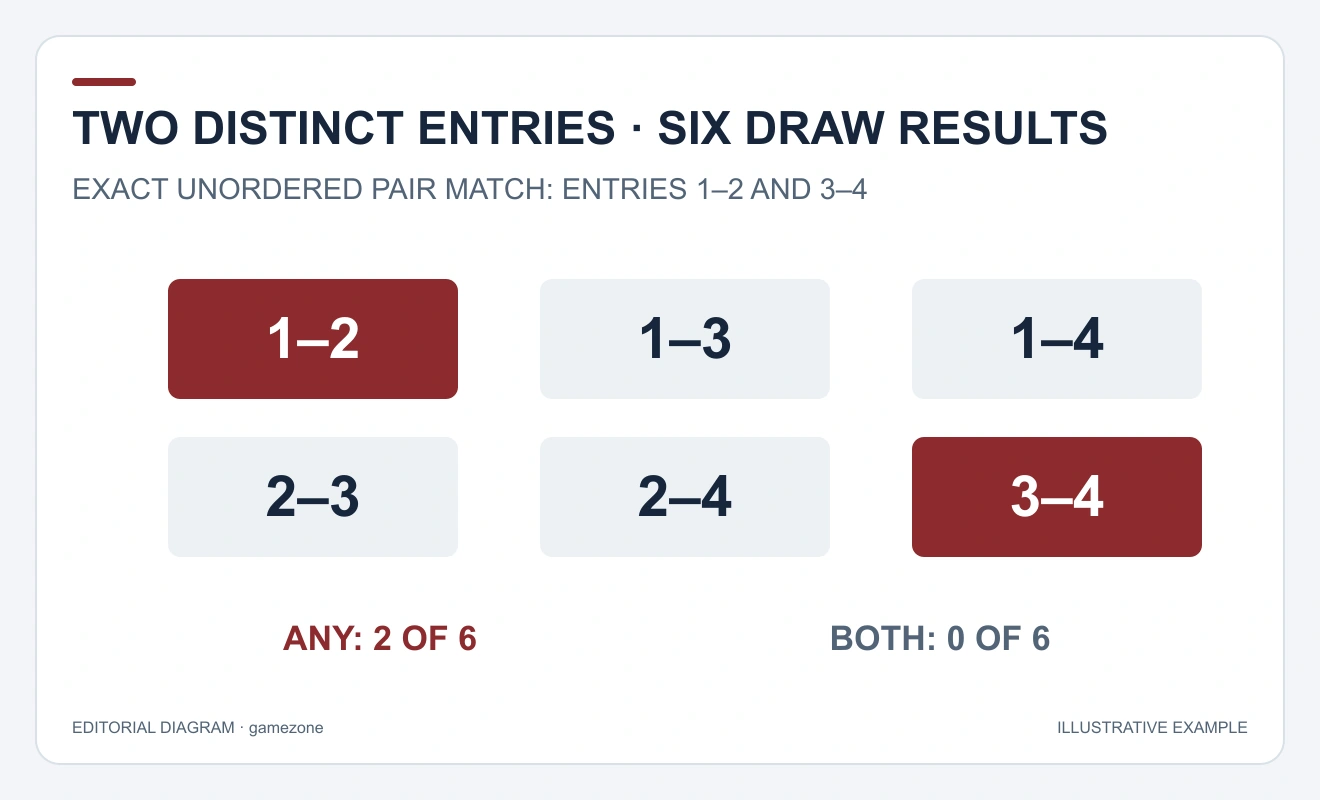
A single draw cannot equal two different exact pairs simultaneously. The two matching events are mutually exclusive. OpenStax’s event definitions distinguish that property from independence. It would be incorrect to multiply 1/6 by 1/6 and claim a 1/36 chance that both different pairs exactly match this one draw.
What changes if the two tickets are identical?
Now replace the second entry with another 1–2. There are still two tickets, but only one distinct matching result: 1–2. In this experiment, the event “any ticket matches” and the event “both tickets match” now both occur on that same one outcome. Their probability is 1/6, not 2/6.
The duplicate could matter for an actual prize allocation if a real game accepts and pays multiple copies, but that requires its separate rules. The worksheet establishes coverage of results only; it does not assign a prize per copy.
A partial-match rule creates another problem
Suppose the criterion is changed to “at least one number matches.” A draw of 1–3 now shares a number with each of the original entries 1–2 and 3–4. Both entries pass that new criterion even though neither exactly matches the drawn pair. The earlier zero-intersection conclusion must not be carried over to this different event.
For the original complementary entries, every possible draw shares at least one number with at least one entry. Four results—1–3, 1–4, 2–3 and 2–4—share a number with both. Thus the partial-match counts are six of six for any and four of six for both. No real prize rule is implied.
Keep four fields beside the calculation
- The draw’s accepted result format, including order and replacement.
- Each accepted entry’s identity and numbers, preserving duplicates.
- The match criterion: exact pair or a specified partial match.
- The question being counted: any entry, every entry or one named entry.
List the matching outcomes for each entry, combine them without duplicates for “any”, and retain only their shared outcomes for “every”. If the actual result space or acceptance status is missing, leave the probability unresolved. A visible count of tickets alone cannot fill those gaps.